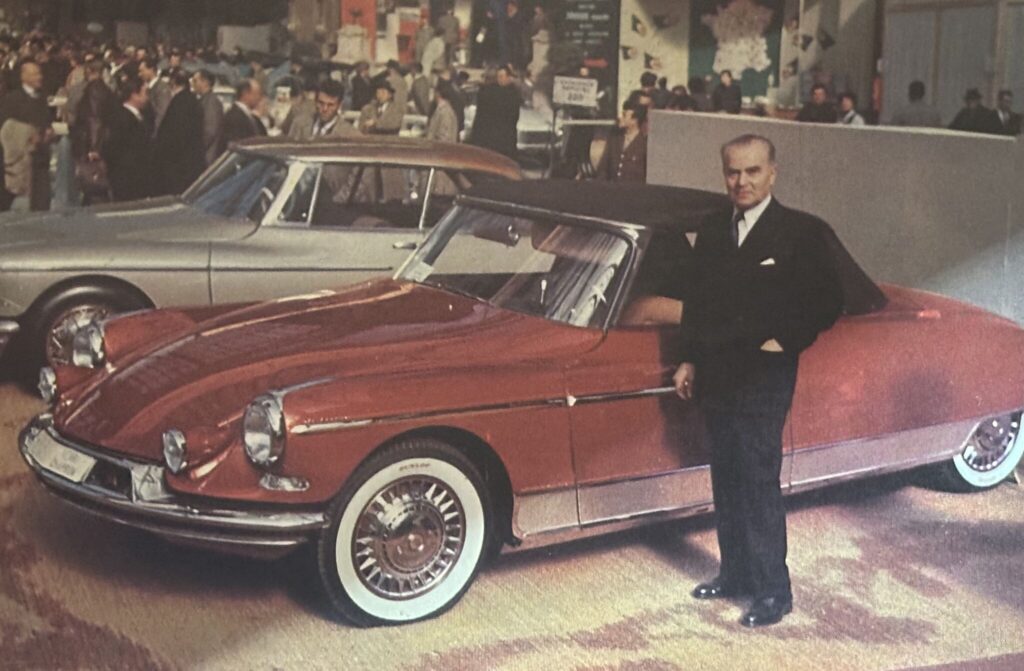
Henri Chapron represents a distinctive chapter in French automotive history. His work captured the elegance, craftsmanship, and refinement associated with traditional coachbuilding, while also showing how a great carrossier could adapt to a changing industry. From early custom bodies on Ford chassis to celebrated creations based on the Citroën DS and SM, Chapron built a legacy that bridged two very different eras of car design.
Chapron began his career in 1919, creating bodies on Ford Model T chassis left behind after the First World War. Over time, his business developed into one of the most respected French coachbuilders, alongside names such as Figoni, Saoutchik, Le Tournier & Marchand, and Pourtout.
Before the Second World War, he produced bodies for many of France’s grand marques, including Hispano-Suiza, Talbot-Lago, and Delage. The decade before the war became one of the most remarkable periods in French automotive design, with flowing lines, elegant proportions, and some of the most striking cars ever built in the country.
After the war, the traditional world of separate chassis and bespoke bodywork began to disappear. Monocoque construction and large-scale production changed the industry permanently, and many famous coachbuilders could not survive that transition.
Chapron, who had employed more than 300 people before the war, needed a new direction. He found it in Citroën. Having already created a presidential version of the Traction Avant 15-Six, he understood the possibilities offered by Citroën engineering. The strong central structure and separate body panels of the DS Break gave him enough flexibility to continue producing highly specialized cars.
In 1958, Chapron introduced the Croisette, a full cabriolet based on the Citroën DS, before Citroën had launched an official convertible of its own. That initiative led to direct collaboration with the factory, which asked Chapron to build the Décapotable as an official cabriolet model.
The result was a car of exceptional style and exclusivity. It cost roughly twice as much as a standard DS, and only 1,365 examples were produced. Alongside the factory-backed Décapotable, Chapron continued to apply his traditional skills to one-offs and small series.
Chapron’s reputation extended far beyond private customers. His cars were used by leading public figures, including General Charles de Gaulle. His work remained relevant into the era of the Citroën SM, proving that traditional craftsmanship could still have a place in modern automotive design.
He lived long enough to see his creations used on the highest ceremonial level, including by President Georges Pompidou and Queen Elizabeth II in a four-seat SM cabriolet. When Henri Chapron died in 1978 at the age of 92, he had already secured his place as one of the last great names in French coachbuilding.
After his death, the company continued for a time under his wife’s direction, producing special versions based on the Citroën CX and Peugeot 604. Even so, the business eventually disappeared in bankruptcy, marking the end of one of the last great French coachbuilders.
The story of Henri Chapron remains extraordinary. Few careers in automotive history stretch so convincingly from custom-bodied Ford Model Ts to elegant Citroën SM specials. His legacy is not only one of beautiful cars, but of resilience, craftsmanship, and the enduring appeal of French coachbuilding.