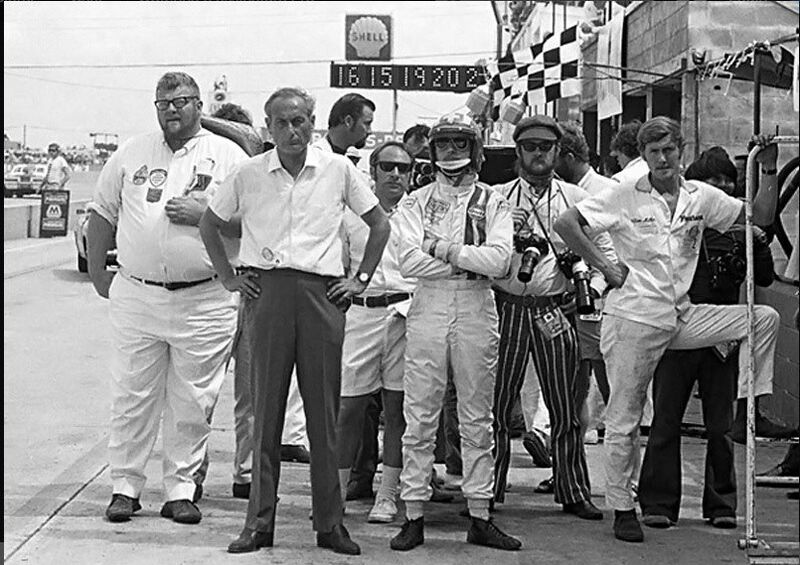
There was a time when racing was not spectacle first, but serious business run by serious men. The 1970 12 Hours of Sebring offers one such moment: Jo Siffert at the wheel of a Gulf-liveried Porsche 917, sharing driving duties with Pedro Rodriguez, while nearby stands David Yorke, John Wyer’s team manager, wearing an expression that suggests the day is not unfolding as hoped.
It is a photograph rich in tension and character. Siffert, one of the era’s most admired drivers, represents the cool precision of top-level endurance racing. Yorke, stern and visibly unimpressed, embodies the disciplined and unsentimental world behind the pit wall. Together, they capture something essential about long-distance racing at its peak: immense speed, immense pressure, and little patience for romance in the heat of competition.
The Sebring race of 1970 formed part of an era when endurance racing stood among the most demanding disciplines in motorsport. Success was never guaranteed, even for the most formidable teams. The Gulf Porsches had become some of the most visually recognisable competition cars of their generation, dressed in that now-legendary pale blue and orange livery, yet recognition alone did not win races. Sebring, with its punishing surface and relentless demands on machinery and driver alike, had a way of exposing weakness and frustrating expectation.
In this image, there is a strong sense that Yorke already understands the direction in which the race is heading. The Gulf Porsche 917s, despite their pace and engineering brilliance, were not going to take victory that day. It is precisely this note of disappointment that gives the scene its enduring authenticity. Motorsport history is not built only on triumph, but also on the quiet, hard-edged acceptance of setbacks.
Jo Siffert was one of the defining figures of late-1960s and early-1970s racing, admired for both his courage and his mechanical sympathy. In the Porsche 917, he was handling one of the most dramatic and capable racing cars of the period — a machine that combined staggering speed with a reputation for demanding respect. Shared here with Pedro Rodriguez, another of endurance racing’s towering talents, the 917 stood at the forefront of international sports car competition.
The Porsche 917 would become one of the great icons of motorsport history, but in period it was not viewed through a nostalgic lens. It was a working weapon — fast, difficult, expensive, and central to the ambitions of one of racing’s most accomplished teams. That seriousness is visible in every line of the car and every face around it.
David Yorke was far more than a team manager with a clipboard and a concerned look. He belonged to a generation shaped by war, discipline and responsibility. During the Second World War, he flew Hawker Hurricanes in the Battle of Britain and was later stationed in India. Men of that background carried themselves differently, and motorsport in that era was still populated by figures whose authority had been forged far beyond the racetrack.
Before joining John Wyer’s legendary Gulf team, Yorke had already built a distinguished career in British motorsport. He worked with Vanwall and Aston Martin, two names deeply woven into post-war racing history, before becoming part of one of endurance racing’s most revered operations. Under Wyer, Yorke helped oversee cars that would come to define an age: the Ford GT40 and the Porsche 917 among them.
The John Wyer Gulf team remains one of the most admired outfits in racing history, not merely because of its colours, but because of the extraordinary machinery it fielded and the standards it upheld. The combination of technical excellence, strong personalities and uncompromising competition made it one of the great professional teams of the endurance racing world.
This Sebring image reminds us that behind every famous livery and every celebrated car stood individuals of formidable character. Drivers like Jo Siffert and Pedro Rodriguez carried the danger and the glory on track, while men like David Yorke carried the burden of organisation, expectation and consequence behind the scenes.
It is a scene from a time when racing was hard, direct and unsentimental — and all the more compelling for it. Serious business, run by serious men, with some of the most spectacular racing cars ever created.